
Postgraduate Certificate in Generative AI and Agentic AI
- Learn to build production LLM, RAG, and multi-agent systems
- Earn a prestigious AIM Postgraduate Certificate
- Access AIM Alumni Benefits along with a 1-day campus immersion
- Hands-On with 30+ AI Tools
The program learning will pause for holidays during Christmas (24 Dec 2026 – 1 Jan 2027) and Chinese New Year (5 Feb – 12 Feb 2027).
Future-Proof Your Career
Emeritus and Asian Institute of Management unite to offer an exclusive opportunity. Enroll by Invalid liquid data using the code: APAC5PERCENT9622 and receive a 5% program fee benefit. Limited seats are available. Reserve your spot today!
What Is the Postgraduate Certificate in Generative AI and Agentic AI About?
Generative AI and large language models are rapidly reshaping enterprise technology stacks, with organisations deploying AI to drive productivity, automation, and data-led decision-making. Demand for advanced talent continues to surge, placing every serious online artificial intelligence program at the centre of business transformation. Across APAC, adoption is accelerating. In the Philippines, nearly half of the professionals report using Generative AI regularly. Yet while experimentation is widespread, production-grade capability in agentic AI, LLM engineering, retrieval-augmented generation, multi-agent orchestration, and AI governance remains limited.
34%
57%
The Asian Institute of Management Advantage
#1
#2
#6
What makes the Postgraduate Certificate in Generative AI and Agentic AI distinctive?

Deploy a production-ready generative or agentic AI solution.

Receive a certificate from the Asian Institute of Management.

Build hands-on expertise with 30+ AI tools

Deep focus on Generative & Agentic AI including LLMs, RAG, and multi-agent systems.

Live Sessions by Industry Experts & Faculty Masterclasses

Attend a 1-day campus immersion and graduation.

AIM Alumni Status and Benefits

Production-Ready Deployment & Governance Focus

5-unit credit towards AIM's Postgraduate Diploma in Management
Basic programming familiarity is recommended. Learner should be comfortable with the concept of writing code (e.g., having used Python in a course, tutorial, or work context). Learners with no prior exposure to any programming language may need to invest additional time and effort to keep pace.
What Will You Learn in the Postgraduate Certificate in Generative AI and Agentic AI?
By the end of the program participants will be able to:
Apply Generative and Agentic AI to build intelligent business solutions.
Design AI-driven workflows and autonomous agents integrated with enterprise systems.
Use AI strategically to drive innovation and decision-making.
Deliver a real-world Agentic AI capstone demonstrating business impact.
Who Should Enroll for the Postgraduate Certificate in Generative AI and Agentic AI?
AI & Data professionals who want to move beyond traditional ML and prompt engineering to build autonomous, production-ready AI systems that position you as a next-generation AI architect.
Product Innovators & Automation Engineers who want to design and lead intelligent AI-powered products and workflows that transform business performance without needing to become a deep AI coder.
Professionals in Finance, Marketing, HR, Legal, Healthcare, and Education who want to integrate AI agents into their workflows to automate research, customer support content generation and operational tasks.
Basic programming familiarity is recommended. Learner should be comfortable with the concept of writing code (e.g., having used Python in a course, tutorial, or work context). Learners with no prior exposure to any programming language may need to invest additional time and effort to keep pace.
Postgraduate Certificate in Generative AI and Agentic AI Curriculum
Phase 0: Programming Fundamentals
Module 1: Introduction to Programming Fundamentals
Explain core Python syntax, data types, and control structures
Apply conditional logic and loops to solve basic programming problems
Write and execute Python scripts to process user input
Debug and fix common syntax and runtime errors
Setting up github repository, managing codebase using github (commits, push, conflict resolution)
Module 2: Data Handling & EDAs
Apply Python data structures to organize and store data
Read and write external data files (CSV, JSON) using Python
Use NumPy arrays to perform vectorized numerical computations
Analyze structured data using Pandas DataFrames and operations
Create basic data visualizations to identify patterns and trends
Interpret exploratory data analysis (EDA) results to derive insights
Module 3: Web application, LLM API calls & coding structure
Interact with OpenAI-compatible LLM APIs using structured prompts and responses
Understand system prompts, user prompts, and LLM parameters (temperature, max tokens)
Create your own API endpoint using FastAPI
Apply object-oriented concepts for code structure, modularity, and reusability
Web application concepts and architecture
Module 4: Coding with AI
Designing AI-Native applications
Design thinking with AI
Spec driven development
Setup Cursor rules, agents.md, claude code, etc.
Understand Web Infrastructure, github actions
Deploy applications to the web
Phase 1: AI Foundations
Module 5: Machine Learning and Neural Network
Introduction to machine learning
Introduction to neural network
Understand concepts of NN: Layers, tokens, embeddings, gradients, back propagation
Module 6: NLP and Transformer Architecture
How the original Transformer architecture works
Identify appropriate use cases and limitations of GenAI systems
Understand different LLM architectures
Understand key components of transformer model
Module 7: Training and Reasoning Models
Understand components of transformer
In-depth code analysis of transformer
Pre-training, Post-training of LLM models
How reasoning models work
Module 8: Pydantic and Langchain
Define data models with Pydantic Base Model
Validate and handle type errors automatically
Call LLMs through LangChain's chat interface
Build reusable prompt templates with variables
Parse LLM responses into Pydantic models
Phase 2: Generative AI
Module 9: GenAI Tools, Prompt Engineering & Frameworks
Apply prompt engineering techniques (zero-shot, few-shot, chain-of-thought, ReAct) to improve LLM output quality
Integrate LangChain and PydanticAI to structure and chain LLM interactions
Evaluate prompt effectiveness through systematic comparison
Understand structured output generation and validation
Module 10: Vector Database, Retrieval Augmented Generation and Tool calls
Understand vector databases
Implement storage and indexing strategies for embedding vectors
Understand different chunking techniques and its effect
Integrate tool calling/function calling to extend LLM capabilities with external data sources
Module 11: Eval & Synthetic Data Generation
Establish evaluation frameworks using RAGAS metrics
Implement performance monitoring using LangSmith or equivalent observability tools
Generate synthetic evaluation datasets that represent realistic query patterns
Analyze RAG system performance bottlenecks and implement optimization strategies
Module 12: Context Engineering & LLM Monitoring
Differentiate between sparse (BM25, TF-IDF) and dense (embedding-based) retrieval approaches
Implement hybrid retrieval systems that combine sparse and dense methods for improved accuracy
Build multi-hop retrieval systems that answer complex queries requiring multiple information sources
Apply RAPTOR (Recursive Abstractive Processing for Tree-Organized Retrieval) for hierarchical document processing
Design memory systems incorporating both long-term (vector DB) and short-term (conversation history) context
Module 13: Reasoning, caching and guardrails
Configure prompt caching to reduce latency and API costs for repeated context
Implement guardrails for content filtering, safety controls, and output validation
Optimize inference costs through strategic use of different model tiers
Evaluate trade-offs between model capabilities, speed, and cost for production use cases
Module 14: Building & Deploying Knowledge-based Applications
Build production-ready RAG applications using Chainlit, Streamlit, or Next.js frameworks
Design user interfaces that effectively display retrieved context and generated responses
Implement authentication, rate limiting, and usage tracking for multi-user deployments
Structure knowledge bases with metadata, versioning, and update mechanisms
Module 15: Model fine-tuning
Distinguish between when to use RAG, prompt engineering, agents or fine-tuning for specific use cases
Prepare and curate high-quality datasets for domain-specific model fine-tuning
Configure and execute fine-tuning jobs using Arcee's platform for specialized model adaptation
Phase 3: Agentic AI
Module 16: Generative AI in Business & Society
Analyze industry-specific GenAI use cases
Evaluate business value and ROI of GenAI solutions
Identify organizational and adoption challenges
Module 17: Tools & Frameworks for Agentic AI
Explain the core concepts of agentic AI: autonomy, tool use, planning, and reasoning loops
Compare agentic frameworks (LangGraph, CrewAI, OpenAI Assistants API)
Build a simple agent with tool-calling capabilities using LangGraph
Understand when agentic solutions are appropriate vs. RAG or fine-tuning
Module 18: Agent Architectures
Compare autonomous agents (goal-driven, self-directed) versus workflow agents (predefined paths)
Evaluate risk-reward trade-offs between agent autonomy levels
Create hybrid systems that combine autonomous reasoning with workflow safety nets
Create agent skill libraries organized by domain (web interaction, data processing, communication)
Module 19: Multi-Agent Systems
Architect multi-agent applications with specialized agent roles
Design coordination mechanisms (supervisor, hierarchical, democratic patterns)
Design scratchpad/working memory systems for multi-step reasoning
Configure summary memory to compress long conversations efficiently
Implement MCP servers and clients with proprietary data sources
Module 20: Deep research and agent evals
Build multi-agent research systems that synthesize information from multiple sources
Configure A2A servers for standardized inter-agent communication
Build authentication and authorization for secure agent interactions
Implement agent cards (metadata about agent capabilities and interfaces)
Module 21: Multimodal AI
Understand how multimodal LLMs process images, audio, and video alongside text
Implement vision-language pipelines for image understanding, OCR, and visual Q&A
Apply multimodal prompting techniques to extract structured data from documents and images
Evaluate multimodal model capabilities, limitations, and appropriate use cases
Phase 4: Applications, Ethics & Projects
Module 22: Case Studies & Mini-Project
Apply agentic AI concepts to real-world problem scenarios
Test and debug agent systems for reliability
Prepare a functional prototype for capstone readiness
Module 23: Responsible & Ethical AI
Identify ethical risks and biases in AI systems
Apply responsible AI principles to system design
Evaluate AI deployments for compliance and governance
Design safety guardrails for autonomous agent behavior
Phase 5: Capstone Project
Module 24: Capstone Project – Build & Iterate
Design an end-to-end Agentic AI solution architecture
Implement automated workflows using agents and tools
Setup evaluation metrics
Test, iterate, and refine agent behavior based on feedback
Module 25: Capstone Project – Final Submission
Finalize and deploy a complete Agentic AI solution
Document architecture, design decisions, and outcomes
Submit and present the completed capstone project
Tools Covered in the Postgraduate Certificate in Generative AI and Agentic AI


























Disclaimer: The tools and technologies referenced are illustrative and not exhaustive. The program covers a broader range of tools, frameworks, and platforms as part of the curriculum. AIM reserves the right to update, modify, replace, or discontinue specific tools or technologies to reflect evolving industry standards, software availability, or academic considerations without prior notice.
Faculty for the Postgraduate Certificate in Generative AI and Agentic AI

Juan Alvaro Estrada
MD, MSDS
Orthopedic surgeon and data scientist, Dr. Estrada bridges clinical excellence with technological innovation. A full scholar graduate of the Asian Institute of Management’s MS...

Allan Tan
Founder and Chief AI Scientist at Predictive Systems, Inc., Allan builds secure, explainable on-premise generative AI solutions. A serial tech entrepreneur with 20+ years of e...

Mr. Christopher Nash A. Jasmin
Data Scientist at the Education Center for Artificial Intelligence Research (ECAIR) under the Department of Education, Christopher Nash A. Jasmin works on AI and data initiati...
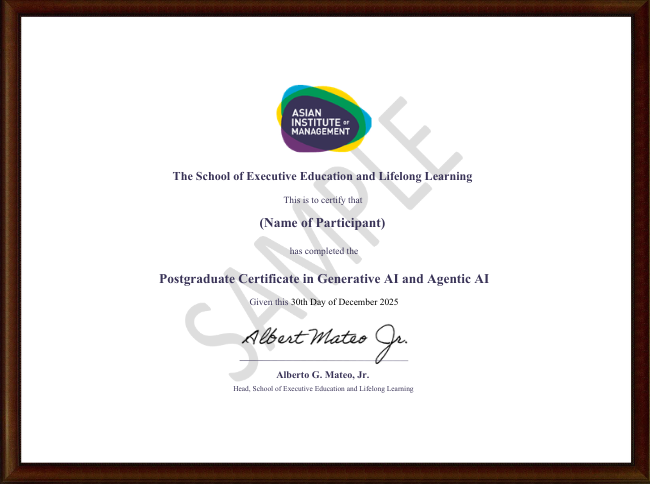
Certificate Awarded on Completion of the Postgraduate Certificate in Generative AI and Agentic AI
Participants who successfully complete the program receive a certificate issued by Asian Institute of Management. The program also counts toward eligibility for alumni status, which provides access to alumni clubs, events, and professional networks.
Emeritus career services
Emeritus provides the following career preparation services:

Resume building videos

Interview preparation videos

Linkedln profile building videos

Interview guidebooks

Glossary of resume templates
Note: AIM or Emeritus do not promise or guarantee a job or progression in your current job. Career Services is only offered as a service that empowers you to manage your career proactively. The Career Services mentioned here are offered by Emeritus. AIM is not involved in any way and make no commitments regarding the Career Services mentioned here.
Postgraduate Stackable Certificate Courses
Eligible Programs for Postgraduate Diploma Credit
Postgraduate Certificate in Project Management
Supply Chain and Operations Management with AI and Analytics
Postgraduate Certificate in Human Resource Analytics and AI
Chief Executive Officer (CEO) Program for the AI Era
Chief Financial Officer (CFO) Program in the Age of AI
Chief AI and Digital Officer (CAIDO) Program
Financial Management with AI
Executive Certificate in Leadership with AI
Postgraduate Certificate in Generative AI and Agentic AI
Full Stack Development with AI
Executive Certificate in Healthcare Management with AI
Information Technology Management with AI
Successful completion of the above programs grants participants five (5) unit credits toward the Postgraduate Diploma in Management.
Disclaimer: To earn the Postgraduate Diploma in Management, a total of twenty (20) units must be completed within three (3) years
Earn a 5-unit credit to AIM's Postgraduate Certificate in Management
The Learning Experience
What is it like to learn with the learning collaborator, Emeritus?
More than 300,000 professionals globally, across 200 countries, have chosen to advance their skills with Emeritus and its educational learning partners. In fact, 90 percent of the respondents of a recent survey across all our programs said that their learning outcomes were met or exceeded. All the contents of the course would be made available to students at the commencement of the course. However, to ensure the program delivers the desired learning outcomes, the students may appoint Emeritus to manage the delivery of the program in a cohort-based manner during the course period the cost of which is already included in the overall Course fee of the course.
A dedicated program support team is available 7 days a week to answer questions about the learning platform, technical issues, or anything else that may affect your learning experience.
AIM Alumni Status and Benefits
AIM alumni can be found at the highest levels of responsibility in private, public, and non-profit sectors throughout the Asia-Pacific and in other parts of the world.
Join the vast network of AIM Alumni, and collaborate with an exclusive league of industry experts as you gain access to special resources, benefits, perks, and offers.
Networking Opportunities
47,000+ alumni in over 79 countries
Exclusive invites to events
Alumni Engagement Platform: www.myaimconnect.com
Use of Facilities in the Knowledge Resource Center
18,000 Printed Materials
Half a Million Electronic Files
Management Research Reports
International Databases such as Euromonitor, EBSCO
Special Savings and Pricing
Programs, Seminars, and Conferences
Partner Establishments
20% off on AIM SEELL Courses
Exclusive invites to events including:
Brewing@AIM
Class Reunions
Annual Homecoming Events
President’s Cup
Beer Pubs
Mentoring Program
Masterclasses
*All benefits are subject to change at the direction of the Asian Institute of Management.
About Emeritus
The Asian Institute of Management (AIM) is collaborating with online education provider Emeritus, to offer a portfolio of high-impact online programs. This collaboration allows AIM to expand its reach beyond its on-campus offerings, delivering a collaborative and engaging learning experience while maintaining the Institute's renowned quality.
FAQs About AIM Postgraduate Certificate in Generative AI and Agentic AI
What is the Postgraduate Certificate in Generative AI and Agentic AI about?
The Postgraduate Certificate in Generative AI and Agentic AI is a comprehensive artificial intelligence program which equips participants to design, deploy, and optimise enterprise-ready generative and agentic AI solutions, enabling them to lead high-impact initiatives with technical authority and strategic confidence.
What topics are covered in the curriculum of Postgraduate Certificate in Generative AI and Agentic AI?
The program curriculum has 25 modules across 5 phases. The curriculum covers generative AI fundamentals, large language models (LLMs), prompt engineering, retrieval-augmented generation (RAG), agentic AI, and multi-agent systems, along with AI system design, evaluation, and governance. The program follows a hands-on, applied learning approach with case studies, tools, and projects, enabling participants to build and deploy scalable, enterprise-ready AI solutions.
What is the program fee for Postgraduate Certificate in Generative AI and Agentic AI?
The program fee varies based on the session and enrollment period. For the latest fee structure, please refer to the program’s brochure or contact the program advisor.
Are there any installment or finance options available?
Yes, installment or flexible finance options are available to help participants manage the course fee in a flexible manner. Details about payment plans can be obtained by reaching out to the program advisor.
What key skills will I gain from Postgraduate Certificate in Generative AI and Agentic AI?
Participants will gain the ability to apply generative and agentic AI to build intelligent business solutions, design AI-driven workflows and autonomous agents integrated with enterprise systems, and use AI strategically to drive innovation and decision-making. The program also enables learners to deliver a real-world agentic AI capstone project that demonstrates measurable business impact.
What is the duration of the Postgraduate Certificate in Generative AI and Agentic AI?
The duration of the program is 6 months, combining live sessions by the industry experts and few masterclasses by AIM faculty.
Who should enroll for the Postgraduate Certificate in Generative AI and Agentic AI?
This program is ideal for AI and data professionals looking to build production-ready, autonomous AI systems, as well as product innovators and automation engineers aiming to design AI-powered solutions without deep coding expertise. It is also suited for professionals across functions such as Finance, Marketing, HR, Legal, Healthcare, and Education who want to integrate AI agents into workflows and automate business processes.
Is this an agentic AI program?
Yes. This is a 6-month live online agentic and generative AI program where you learn to design and deploy autonomous AI systems, including multi-agent workflows, LLM-based applications, and enterprise-grade AI solutions.
Does this program require a coding background?
Basic programming familiarity (such as Python) is recommended, and learners should be comfortable with the concept of writing code. The program focuses on applied learning to help you build production-ready LLM, RAG, and agentic AI systems and hence those with no prior coding experience may need extra effort to keep pace.
Early registrations are encouraged. Seats fill up quickly!
Flexible payment options available.
Starts On